Attending my duty

Me
Monday, 12 December 2011
Dowry payments in S. Sudan have bad impact in the country.
By Ariik Atekdit,
ariqdudic@gmail.com
Akoi Madol, an eighteen year-old girl from Kolnyang District of Jonglei State became the victim of love when she decided to marry her long termed boyfriend in her Dinka community of South Sudan. She was beaten with her sister, Agot Ngong who survived brutal torture with bruises.
“I got a call when I was about to eat. They forced me to move where Akoi was and ordered us to remove all clothes and lay us flat on the ground with face down,” Ngong said. “Four people two with each of us came with ropes, one each side and begin to beat us,” Ngong explained to Sudan Tribune.
According to the article published on Sudan Tribune website Ms Madol was beaten to death on February 28, 2011 after she escaped with her groom who was not of their parents’ choice. Madol died for her love in heart, leaving behind her sister, Agot Ngong suffering from bruises and pain and mourning for her deceased sister. “I tried to escape but they caught me after some minutes. They continued beating us till we were unconscious. I recovered but Akoi died the following morning,” said Ngong attending treatment in Bor Private Clinic.
An eye witness in Malual Agorbaar, ten miles away from Bor town on Bor-Juba road where incident happened said, “The late Akoi escaped with her husband on 19 February. She was accompanied by her sister Agot Ngong and spent one week hiding before they were traced on 25 February. Although warned against it, Akoi returned to the man she wanted to marry. The marriage was rejected and Akoi was brought home by group of man including her brother. The father to the dead girl, Madol Alier beat his daughter for violating his orders and ordered his sons and cousins to continue punishing her,” which in result caused death.
The father to the victim survivor with injuries said that his daughter was cruelly beaten against his will, saying the people responsible must be arrested to face justice.
In South Sudan and especially among communities that keep cattle, girls are understood to be sources of wealth to their families and believed to be forced to marry any men that may afford them without considering love relation between the two couples. Girls are said to have no rights of choosing their future husbands or reject husbands arranged for them by their parents. They are believed to be married without a choice, to deliver children and as well as being confined to kitchen.
Doctors in Bor Civil Hospital said that the death was caused by neck fracture. Her case is not the only dowry related case practiced in South Sudan. Some similar cases are said to have occurred in states like Warrap and Lakes and many other cases occur anywhere and remained untold in various states of South Sudan.
In this way parents or relatives to girls never care so much about the lives of their girls as human beings but they have the mentality of getting bride wealth from grooms once their daughters are married. Once they lose that chance they tend to act violently.
According to South Sudan Transitional Constitution; “every person of marriageable age shall have the right to marry a person of the opposite sex and to found a family according to their respective family laws, and no marriage shall be entered into without the free and full consent of the man and woman intending to marry” as stated in Article 15.
However, the written law remains unimplemented and not observed by the concerned authorities in the nation. As the result there continues to be related crimes committed against the interest of young girls & boys and later tried to be solved by customary law as an excuse of avoiding what the constitution says about them. They do so to suit the interests of parents over their daughters’.
Though, the constitution gives right to youth of different sex to found a family of their own choice, nonetheless, the problem of dowry (bride price) remains unanswered. There is no law that regulates bride prices in some communities. The Transitional constitution never tells how much wealth should be paid to the parents of the girl before she becomes a legal wife to the boy. And there are no written customary laws for better referral as well.
A special report from United States Institute of Peace in the research which was conducted between April and May 2011 in some states in South Sudan cited that; “the increasing inability to meet dowry (bride price) demands was the main research finding. Unable to meet this demands many male youths enlist militias, join cattle raids or seek wives from different ethnic groups or countries.” “The skyrocketing dowry demands have alarmingly and negatively affected the female youth,” the report said.
Though every person is entitled to marry a wife/husband of their choice, this has not been the case of the recent years for the reason that parents keep their demands higher and higher on their daughters and rich people also are ever capable to continue marrying wives as many as possible leaving poor men getting married to only one or none at times. The high inflation in dowry (bride price) has kept young men unable to marry and therefore get scared or frustrated by the situation.
The report said that in pastoralist South Sudan, dowries are measured in cattle: “you cannot marry without cows,” one youth explained, “and you cannot be called a man without cows.” In agricultural areas payments can combine money with cattle or other livestock. There were steady descriptions of a difficult situation getting much worse. “The number of cattle in Unity state is declining,” a male youth in Bentiu explained, “while the price of dowry is going up.” “Dowry is the biggest challenge in South Sudan,” an urban male youth stated simply in the report.
Emmanuel Gambiri in his article said that an educated wife in cattle herding Mundari tribe in South Sudan costs 50 cows, 60 goats and 300, 000 Sudanese pounds ($12, 000) in cash. According to Gambiri some boys who cannot afford a bride price turn stealing livestock in order to buy a wife and gain status. In the past in Emmanuel’s village of Terekeka of Central Equatoria wives cost as little as 12 cows and tribal chiefs wielded enough power to call the parents and set an affordable bride price.
An unpublished UN report states that dowry prices have grown up by 44 percent since the signing of the Comprehensive Peace Agreement (CPA) in Southern Sudan. Some of those interviewed reported that, instead of negotiating a dowry price down, wealth men want to meet the exorbitant demands. The reason given was simple: it provides high public status. “It becomes an ego issue,” a Juba businessperson explained. “The more you pay higher the status of the husband and his new wife received.” Many claimed that Government officials flush with cash were the main cause of dowry inflation. “People who work for GoSS they have money,” a twenty one year old male youth in Juba stated, “So when they want to marry a girl they pay a lot. This makes it more expensive for everyone.”
In South Sudan years before CPA experienced a lot of difficulties with no source of income almost for every south Sudanese because everyone was not employed even the learned former SPLA soldiers. Unlike today some people have got employed as a result of the semi-autonomous government and subsequently with the independence. This has created employment so some people are able to pay more cows or any possible wealth wanted by the girls’ parents.
Some government officials because of no active accountability are involved into corruption, so they can pay high dowry of their wives or wives of their sons using government money.
Now that dowry (bride price) has become so high for an ordinary man strong youths who do not want to die unmarried have decided to join militias to rob or loot people’s properties so that they get wealth for their wives. This has resulted into death of so many people across the country and especially in case of Jonglei state and other states of South Sudan in which cattle rustling is practiced. In view of that Jonglei state’s Governor Kuol Manyang in the 7th Governors’ Forum held in 2009 in Juba, he proposed the reduction or totally abolition of the dowry (bride price) in hope to curb cattle rustling in South Sudan. According to Kuol he said, “We are losing many lives because of the cows and I am telling the house of South Sudan that it is the right time we look into this issue of dowry payment seriously.”
Many lives have been lost as bride price surged. On the other hand girls and women are being denied their basic human rights because of cows. The best example is the story above.

Saturday, 3 September 2011
Let’s stop entertaining negative ideas
By Ariik-Dut Atekdit
In South Sudan we injure ourselves by the negative ideas we entertain. How often have you wounded yourself by getting angry, fearful, jealous, or vengeful? These are the POISONS that enter your subconscious mind; none of us were born with these Negative Attitudes. But the environment has made you look on others with your own negative eyes and suspicion. People have failed many times to think over situations and perform true and accurate evaluations. Due to these, South Sudan is occupied by hatred and jealousy with every person blaming it on others. Every person tries on his/her everyday life to point fingers on others holding them responsibility for all failures and glorify him/herself with what is good. However, that won’t help us out.My new country South Sudan, a nation which is emerging out of war to maybe the most hoped and expected permanent peace has so many problems to be told about it. The country which is coming out of the marginalization needs to lose the culture of peace but trying to cling on the shocking development of war which is a true inheritance of the protracted two civil wars battled by my country-men and the Arab Muslims of Sudan.Indeed one is right to say South Sudanese had never been united even before the arrivals of Arabs or colonizers to Sudan because they had existed in their closed tribal borders for so many years. They came to be united recently during their struggle for freedom against the successive Khartoum Islamic regimes. But with truth, dates beyond can never retained information of any togetherness among various ethnic groups in South Sudan. Though most of the ethnic communities have many similarities among their cultures, distinct tribes had lived for ages without coming beneath solitary rules. So to whom can this be blame on? It was a lack of communications among the communities maybe that had stopped them from getting united. But this must stop with the coming up of the modern South Sudan which is independent with its sovereign Government. Wars of cattle rustling and tribal land grabbing must be brought down by South Sudan leadership before we could announce any failure.
We would actually like the Government of the youngest Republic to work jointly to fight for unity and peace for our local communities. Igniting of tribal or clan conflicts because of political or personal interests may not help since that appears to be an attitude of north Sudan with its Islamic regimes which we had all witnessed in the past. There is no any other way of making South Sudan a prosperous country when it contains a number of tribal wars whose end is not known at all. The best and the only better way is to find a peaceful solution to the nation’s tribal problems. It is supposed to be the extraordinarily work that the appointed cabinet looks into to bring our communities to peace. I am sure it will be ugly for the selected ministers and the elected MPs to sit in their luxurious offices of the world’s newest state without diagnosing the internal problems in their motherland country. There will be no anymore possible excuses to blame chaos in South Sudan on Khartoum as an enemy or the opposition political parties as the strikers of tribal clashes.
As we know that every MP comes from a constituency in South Sudan it is also the same that our national ministers represent vast geographical regions in the country. It won’t take them long if the work together to combat tribalism as that would very well easy a way out for corruption in the country.
It is sometimes hopeless to find that the hardest headlines of our day to day news in South Sudan is all about violence which results into death of hundreds of lives every now and then. We were expecting our hardest headlines to carry developmental news. It is good for any leadership to continue leading and find a way out to solve the situation. The problem of Lou Nuer and Murle communities needs to be solved before darkness. We can’t talk of peace and rule of law when the necessary security is not provided to the citizens.
Our government should work hard to bring education and development to our rural villages in order to engage the civil population. Otherwise it has been a long holiday for development to work since 2005. The former Government of Southern Sudan (GoSS) was termed to a very small child for so many until it got outdated. I hope the Government of the Republic is born an adult to avoid us wasting a lot of time without development. We need not to entertain leaders who have self-interests in public offices.
In South Sudan we injure ourselves by the negative ideas we entertain. How often have you wounded yourself by getting angry, fearful, jealous, or vengeful? These are the POISONS that enter your subconscious mind; none of us were born with these Negative Attitudes. But the environment has made you look on others with your own negative eyes and suspicion. People have failed many times to think over situations and perform true and accurate evaluations.
 Due to these, South Sudan is occupied by hatred and jealousy with every person blaming it on others. Every person tries on his/her everyday life to point fingers on others holding them responsibility for all failures and glorify him/herself with what is good. However, that won’t help us out.My new country South Sudan, a nation which is emerging out of war to maybe the most hoped and expected permanent peace has so many problems to be told about it. The country which is coming out of the marginalization needs to lose the culture of peace but trying to cling on the shocking development of war which is a true inheritance of the protracted two civil wars battled by my country-men and the Arab Muslims of Sudan.Indeed one is right to say South Sudanese had never been united even before the arrivals of Arabs or colonizers to Sudan because they had existed in their closed tribal borders for so many years. They came to be united recently during their struggle for freedom against the successive Khartoum Islamic regimes. But with truth, dates beyond can never retained information of any togetherness among various ethnic groups in South Sudan. Though most of the ethnic communities have many similarities among their cultures, distinct tribes had lived for ages without coming beneath solitary rules. So to whom can this be blame on? It was a lack of communications among the communities maybe that had stopped them from getting united. But this must stop with the coming up of the modern South Sudan which is independent with its sovereign Government. Wars of cattle rustling and tribal land grabbing must be brought down by South Sudan leadership before we could announce any failure.
We would actually like the Government of the youngest Republic to work jointly to fight for unity and peace for our local communities. Igniting of tribal or clan conflicts because of political or personal interests may not help since that appears to be an attitude of north Sudan with its Islamic regimes which we had all witnessed in the past. There is no any other way of making South Sudan a prosperous country when it contains a number of tribal wars whose end is not known at all. The best and the only better way is to find a peaceful solution to the nation’s tribal problems. It is supposed to be the extraordinarily work that the appointed cabinet looks into to bring our communities to peace. I am sure it will be ugly for the selected ministers and the elected MPs to sit in their luxurious offices of the world’s newest state without diagnosing the internal problems in their motherland country. There will be no anymore possible excuses to blame chaos in South Sudan on Khartoum as an enemy or the opposition political parties as the strikers of tribal clashes.
As we know that every MP comes from a constituency in South Sudan it is also the same that our national ministers represent vast geographical regions in the country. It won’t take them long if the work together to combat tribalism as that would very well easy a way out for corruption in the country.
It is sometimes hopeless to find that the hardest headlines of our day to day news in South Sudan is all about violence which results into death of hundreds of lives every now and then. We were expecting our hardest headlines to carry developmental news. It is good for any leadership to continue leading and find a way out to solve the situation. The problem of Lou Nuer and Murle communities needs to be solved before darkness. We can’t talk of peace and rule of law when the necessary security is not provided to the citizens.
Our government should work hard to bring education and development to our rural villages in order to engage the civil population. Otherwise it has been a long holiday for development to work since 2005. The former Government of Southern Sudan (GoSS) was termed to a very small child for so many until it got outdated. I hope the Government of the Republic is born an adult to avoid us wasting a lot of time without development. We need not to entertain leaders who have self-interests in public offices.
Tuesday, 23 August 2011
Thank U my dear !!!!!
Sometimes we get caught up in life that we forget to thank those who make it worth living.
If I could list the names of those who have blessed my life, there would not be enough room to do so though I know that my mom would take the top of the list. I can’t forget that somebody like you is placed among the first five of the long list of those have supported and made my life what it is today.
In silent ways and in great waves, thank for your inspiration, your love, your jokes, your advice, your kindness, your wisdom and your smiles. Those are not the few good things I can remember about, the list of good things about you is quite gigantic and outsized but my simple and small brain cannot remember all those good things altogether but I hope together you can picture this feeling with me now. In simple gestures you remind me of how blessed I am to occupy this 'space,' at this time and with you.
You give me hope and rejuvenate my excitements at times. You guarantee me that life is more than I sometime believe it to be. Or that I am way off my head. I am not receiving a great reward to elevate the significance of this moment. However, this is in thanks to the gift and the reward. That is, the life that you have given me by contributing to the fabric of my thinking and living.
The 'platform I stand on,' 'the stage' that supports my ideas of others and of self hopefully, reflects the knowledge and the wisdom gained from you. As we grow and outgrow ourselves, as we get old and frail, and if life takes us on different corridors, the corridor that we have travelled have light the strip still ahead.
And in my worst moment and small triumphs I will seek the table of memory' and dust off the old moment to refresh and renew my life myself. So to you all I say thank you.
Especially to my family and my friends and the occasional stranger that smile on a bad day and finally to you.
Be blessed.
Tuesday, 9 August 2011
SALVA KIIR MAYARDIT, PRESIDENT OF THE REPUBLIC ADDRESS TO THE FIRST JOINT SITTING OF THE NATIONAL LEGISLATURE AND TO THE NATION
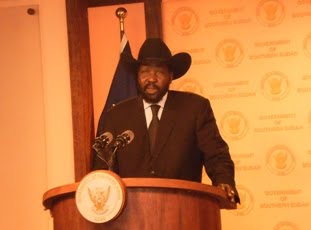

JUBA 8TH AUGUST, 2011
Your Excellency, Dr. Riek Machar Teny, Vice President of the Republic,
Rt. Hon. James Wani Igga, Speaker of the Joint National Legislature and the National Assembly of the Republic,
Rt. Hon. Joseph Bol Chan, Deputy Speaker of the Joint Sitting and Speaker of the Council of States of the Republic,
Honourable Deputy Speakers of both Houses,
The Honourable Chief Justice of the Republic,
Excellencies, Members of the Executive Caretaker Cabinet,
Honourable Members of this Joint august House,
Religious Leaders,
Representatives from all branches of government and states of the Republic,
Distinguished Members of the Diplomatic Community,
Ladies and Gentlemen,
This day is yet another momentous occasion for our nation. The convening of this First Joint Sitting of our two houses: the Council of States and the National Assembly is a historical episode in our life time. These two houses constitute the National Legislature, which is the supreme authority in the land. The interests of the people are fully represented in this noble institution. Thus, allow me the opportunity to congratulate you and welcome you to the first sitting of this august house.
Before I proceed ahead to share with you what I consider to be the pertinent issues of this epoch, please let us rise up and pay tribute to all those who perished in order for this nation to be born. Foremost amongst these heroes and heroines is our great leader and hero, Dr. John Garang De Mabior, whose fond memories are still vivid in our minds (Minutes of silence).
Thank you very much!
Rt. Honourable Speaker,
Honourable members of this august House,
Ladies and Gentlemen,
On July 9th, 2011, we ended a long period of misfortunes by the formal declaration of our independence. We have been occupied, colonized, marginalized and denied our dignity and humanity. This sitting clearly demonstrates the result of our long struggle and the beginning of a new journey for peace, democracy and prosperity. The independence we celebrated a few weeks ago is a great achievement for our people. I am grateful to have witnessed the birth of our nation and to you all comrades, congratulations for being pioneer citizens of this new nation! We are indeed a lucky lot because history has favoured us to be alive to witness this great moment of emancipation. Let us recreate ourselves, let us find new ways, new thinking and be ready to learn in order to adequately meet new challenges. We should not take anything for granted. Instead every challenge should be considered an opening for greater opportunities and triumphs. I urge all of you to seize the opportunities and accept the challenges of the future.
The freedom we have just achieved endows us with power and mandate. In return we must manage what is given to us with utmost care and responsibility. Moreover, as a sovereign body representing the sovereign will of the people of the Republic of South Sudan (RSS), it is incumbent upon this august House to manage the affairs of this land in order to deliver on what we promised to our people. While debating matters of national interest, it is important that we put the well being of our people and nation first. Our people have waited patiently for so long. It is time we act and we do so without delay. Therefore, the two houses must complement each other rather than compete against one another. This is expected of you in the conduct of business and this is critical for nation-building.
As a people who have navigated from far it may not be easy to forget the pains of the past. Our hearts are still heavy with the anguish of history. That notwithstanding we must be brave and wise enough to resist revisiting the past and we must embrace the future. We will not forget the past but the sacrifices of our martyrs will keep us consoled to be worthy of freedom and concentrate all our energies on nation-building. If we deviated away from the core objectives of our liberation struggle, the sacrifices made by many will be for nothing. We were able to achieve our objectives because of the sacrifices of our martyrs and the long suffering of our people. The rewards of our heroes and heroines lie in our future and in the realization of our vision. And it is also in this future and in the realization of this vision that we can fulfill the pledges we have made to our people.
Rt. Honourable Speaker,
Honourable members of this august House,
Ladies and Gentlemen,
Our dreams and hopes can only be met through hard work so that they can become a reality. A democratic and stable South Sudan will contribute to regional and international peace and prosperity. Remember, our independence also has its burdens and we must be ready to face them headlong. As I have pointed out in my past appeals, the worst experiences of the past and those of other nations must be considered in order for us as a new nation not to repeat them. We should not defend ourselves by using the failures of others as a threshold. Let us build our country by striving towards what others have achieved successfully.
As we move forward, the most serious challenge and responsibility we face is what we can deliver for future generations? What would be the best way to honour our heroes and heroines? I said it during Martyrs Day and I will repeat it here that there is nothing material to offer worth the sacrifices of our martyrs. What is worth the ultimate sacrifice they made is for us to build this nation. Nation-building requires cohesion, hard work, honesty and altruism. While I will continue to urge you to work harder, I am already at work. My next government will do the best it can to enhance the welfare of its citizens. Building a nation is not an easy enterprise. It takes time and in most cases those who build hardly reap the fruits of their own labour. Thus, let us keep in mind that we are here to serve our people and not to enrich ourselves. It is our duty to ensure that future generations must not experience the sufferings we have endured. In other words, let us end the promises and deliver the basic services to our people. Misfortunes of the past should end with us and let us set a brighter future for our people.
Rt. Honurable Speaker,
Honourable members of this august House,
Ladies and Gentlemen,
Together with the honourable members of this august Assembly, we must now focus on delivery of basic services to meet the great expectations of our people. This is only possible if we have a government whose first, second and final priorities are public interest, public interest, public interest! Let me make it clear once again that those individuals who are not willing and ready to make the sacrifices necessary to help our people will not be part of this government. Most important, the people of South Sudan will not sit ideally and allow corruption and abuses of public resources to continue unabated. You will agree with me that the people of South Sudan have not only suffered for far too long but they have also waited for basic services for too long. They cannot wait much longer. It is time for delivery and it is also time to put the public interest as the number one priority.
I take this opportunity to announce to this august Assembly that I will appoint the new Government of the Republic of South Sudan this week and according to constitutional requirement I am sending the list of the new cabinet to you for approval. The Ministers that are selected will have to work very hard and be disciplined. The new Government will work towards the ambitious goals set in our National Development Plan, and I will set them to task.
Firstly, for South Sudan as a new nation to develop, we need education. No country has ever achieved development without educating its population. It remains a major challenge that only a minority of our children in South Sudan have access to education. When it comes to girl’s education, it is even worse. All children in our independent country must have the opportunity to go to school. To do this there is a need to scale up education enrolment quickly all over the country. Together with our development partners we can achieve this. We will also encourage our communities to help build schools. To demonstrate our seriousness, within the first 100 days of the new government 30 new primary schools and four new secondary schools will be under construction. Together with our development partners, we will also launch a Teachers Training Development Program aiming at training 7000 teachers in the next three to five years. We are also going to build higher education institutions in the coming years. We cannot afford to lose our next generation leaders because of the absence of higher education institutions.
Secondly, the lack of good health care system in South Sudan has made our nation the most difficult place to live, especially for children and senior citizens. Many people still die because of preventable diseases. Let us be honest, you and I, and indeed our family members can afford to go out of the country to get treatment. But this is not the case for the millions of our people. And it is not because of war, rather because of the absence of health services. It is time to change that by providing basic health services for all our people in the villages, Bomas, Payams and Counties. Through community health programmes we can distribute anti-malarial bed nets to more people and save the lives of our children and their mothers. And we will start now.
Similarly, within the first 100 days of the government and together with development partners, we will make sure that 600,000 children are vaccinated against deadly diseases, including measles, particularly in the four states of Unity, Northern Bahr El Ghazal, Warrap and Upper Nile. And the good news is that 30 community midwives will finalize their training and be ready to be deployed to the rural areas. I also intend, with the support of this august House, to construct 100 small health care centers within the first year of this Administration.
Thirdly, South Sudan cannot develop without infrastructure. Our country is vast, and our communications are limited. Only through the use of roads and rivers can communities connect, agricultural production takes off, businesses flourish, the economy grows, and services are delivered. Infrastructure is at the heart of our development plan. Together with our development partners, we will invest in roads and bridges, and in river transport. But also here, we need our people to give a hand. They can help rehabilitate and construct feeder-roads. With the focus of this august Assembly, together, we can make it happen.
Within the first 100 days of the new government two roads and two airstrips will be opened in Unity and Warrap states. The repairs of Juba Bridge and the construction of a new bridge on the Nile donated by the Government of Japan will get underway. The rehabilitation of four roads will be in process, three in Eastern Equatoria State, Warrap and the Pagak-Mathiang road in Upper Nile.
Fourthly, no country can develop without abiding with basic principles of justice and rule of law. South Sudanese have been at the receiving end of aggression, injustices, arbitrary detention and absence of law and order during decades of war. Now similar incidences have occurred among our own police and security institutions. As I said on Martyrs’ Day, this has to end. Criminality should cease or else those who perpetrate suffering to others will be subjected to the strong arm of the law. It is time to put our own house in order. We need to strengthen law and order, both within our own institutions and among citizens.
Within the first 100 days of our new government, 50 new police stations located throughout the country, will be opened. Two prisons will also be completed. Again together with our development partners the Government will do more.
Fifthly, no country can ensure peace and security and protect its citizens without a modern and professional Army. As a new and independent country, we will complete the transformation of the SPLA into a national army. For this to happen successfully, the Government must put in place programs that would provide new opportunities for former SPLA soldiers.
Within the first 100 days, we will launch our new programme for Disarmament, Demobilization and Reintegration (DDR). We will provide tailored programmes to give them a new start.
These are just but few caveats for the beginning. We have got more daunting tasks in front of us – development, development and development! And development does not only come with the donors or with oil money. As I said earlier it requires hard work and discipline. For example, the Republic of South Sudan should never depend on imports of food or handouts. We are endowed with fertile land. I said it and I will repeat it now; we must till the land to produce food. This is a moral responsibility for citizens – work, work, work and work! I want to reiterate again, a prosperous nation is not made up of indolent citizens, because laziness is useless. As pioneer members of this joint august Parliament, I call upon you all to help mobilize our communities to service in order to help develop our nation. We can only achieve our ambitious development goals if all of us dedicate ourselves to develop our country and pull together with unity of purpose.
On Independence Day I made it clear that from now onward we do not have any excuses or scapegoats. It is our responsibility to protect our land, our resources and ourselves and to develop our country. Moreover, the goat is dead therefore there is no one to blame!
Rt. Honourable Speaker,
Honourable members of this joint august sitting,
Ladies and Gentlemen,
For South Sudan to succeed, we need to abide with the principles of transparency and accountability. Only then can we build a strong foundation for our new nation. Another word for corruption is stealing and it is called ‘stealing’ because money which should have gone to build our country is stolen by selfish persons. Those who engage in corruption are undermining our country and the sovereignty of the Republic of South Sudan. To borrow from our liberation laws, join me in defining corrupt persons as the enemies of the people. We must therefore fight corruption with dedication, rigour and commitment. And that is why, on Independence Day, I pledged to the people, the nation and the heads of state and government present that I would do all that I could to remove this cancer.
Most important, let me put a human face on what corruption does to our people and country. With the amount of funds stolen over the past six years and half; we could have saved thousands of our citizens from unnecessary deaths and suffering, building more than a dozen of schools and hospitals, and feed many of our citizens.
At this juncture, allow me to take permission from this august Assembly to outline key priority expectations of your business in the first 100 days. This requires us to change the way we have been doing things and become more disciplined. For example, timekeeping has been one of the worst vices of the old Sudan. This honourable legislative body has loads of work to deliver to this nation, critical amongst which is legislation itself. We must pass crucial laws to cement our sovereignty and independence. There is need to work even extra harder in order to expedite the process of legislation and achieve the following:
One, in the first 100 days I will make sure that the new Government of the Republic of South Sudan passes 5 essential laws to establish full transparency and accountability in the management of our financial resources, natural resources and oil. Thus, we will send to Parliament a Public Financial Management and Accountability Act, a Procurement Act, an Internal Audit Act, a Petroleum Act for regulating the management of oil resources, and an Oil Revenue Management Law for sustainable and transparent management of the oil income.
Several of these laws are already prepared, and all of them will hold international standards. This is an essential part of putting our new Republic on a solid foundation cemented by the blood of our martyrs. I call upon you, the National Legislature of the new Republic of South Sudan, to process and pass these laws without delay. We need them to take effect as soon as possible.
Two, implementation of these Acts is essential. Within the first 100 days, the Republic of South Sudan will develop an implementation plan to put these policies into practice. This includes rules of procedures for our public service and large-scale training of staff. Here, we will have to ask for external assistance and support. We need to be ready to implement expeditiously as soon as Parliament passes these laws.
In the first 100 days, the Audit Chamber and the Anti Corruption Commission will also be strengthened. We will have audits underway in three of the most significant spending government ministries and agencies. We will take action on their findings and as I have pointed out before there will be no loopholes for people who are addicted to mishandling public resources. There will be no sacred cows this time round. Moreover the Anti-Corruption Commission has already been granted the right to independent investigations but the institution itself also requires restructuring. I will urge the Commission to make use of this right within the first 100 days. The Commission and its members will have my full support as President of the Republic.
Three, implementation always starts at home with us as political leaders. In all South Sudanese communities stealing is seen as deeply shameful! We all know what happens in our cultures and communities, particularly, if one is caught stealing? The community will start composing songs against you, and the whole family will be disgraced. Your children will have difficulties getting married respectably, and you cannot even become a chief or be in any position of authority.
I always wonder what has happened to these core values of our communities. It seems that people have forgotten them. This has to change and with determination it will change. We must set new standards to be eligible for public office. When the government is appointed I will make these standards clear to the public, and I will expect every Minister and civil servant to abide by these standards. The Republic of South Sudan will expect nothing less from those who serve our newly independent country.
With these actions, I hope we will have taken the first critical steps to put our new country on a solid footing. Remember no government performs well without checks and balances. The primary role of Parliament is, therefore, essential in this process. I request you, our Parliamentarians and our international partners, to assist us and to hold us responsible in the implementation process of these pledges. I will report back to you on all these deliverables when our first 100 days have passed. I promise you that this time, we will deliver.
Rt. Honourable Speaker,
Honourable Members of this Joint Assembly,
Distinguished Ladies and Gentlemen,
I shall be remiss if I do not say something about the Comprehensive Peace Agreement (CPA), particularly about the issues that are still outstanding. I would like to reassure all that Abyei is not a forgotten cause because we will remain actively seized of the matter until a final resolution is found. We are all aware that the United Nations Security Council has authorized the deployment of the UN Interim Security Force for Abyei (UNISFA) in order to ensure resettlement of the people of Abyei back in their homes. I trust that a final solution will be found that will reflect the true will of the people of Abyei. I am equally committed to ensuring peace and security along our common borders and the spirit of good neighbourliness is one of the guiding principles of our foreign policy. The massive attendance of the world during our independence celebrations is testimony that we are a friendly people. We will continue to engage with all our neighbours, particularly with the leadership in the Republic of the Sudan to build strong relations because we share a long border.
Finally, I would like to repeat what I said during the declaration of independence. Let us continue to celebrate our hard won freedom but we must always be sober to wake up the following day and work. I reiterate my appeal to this august House that this new nation is yours and let us commit ourselves to build it with optimism. Hard work is a virtue and in just a matter of time, we will prosper. There is nothing impossible and as it is said: ‘If there is a will there is a way’. The role of government is to provide a conducive atmosphere while citizens must join hands and work. We will issue comprehensive priorities for the next five to ten years as soon as the new cabinet is constituted.
Let me say this again we cannot prosper as a nation without the unity and harmony of our people. We must accept our diversity and use our difficult past experiences to grow. We must work harder and harder so that in five years change must be apparent. Government will ensure that there is no hindrance or obstacle and people should go about doing their businesses in safety and without any kind of fear.
As for you the honourable members of this joint august House, legislation is your first order of business and I wish you all well in this national duty. I am always available and my office is there to attend to urgent national needs and emergencies.
Let us start to work right away.
Thank you all and may God bless South Sudan!
Sunday, 24 July 2011
The More Girls Bleach, the More Boys Drink Alcohol

Most of the times some of my colleagues in the art of writing have posted articles that cursed the new attitude seen with our girls who bleach in deep search for beauty. Of course this activity has brought down our proud culture and our given African color of black.
Nowadays it is very difficult to find a girl maintaining her original skin. Every girl is under big temptation of trying to become white. As girl reaches the age of around thirteen and above, the African original color of her dear skin shall turn lighter and lighter. And the black skin disappears and finally fades out. Her face will be the browner area in her body yet her legs shall remain spotted up with brown color. And the original black color remains scattered around the legs and at hands and fingers. In fact you will find that an African girl is betrayed by her original black color because everybody will know that the girl has bleached as the spots on her body remain evidence.
When I go out-door the first thing I could glance is a girl who applies cream. That alone hurts my feeling. A girl with wrong face is always and easily seen in our streets as well as in our many bus stations and tea places. In working places and education institutions you will find true black African ladies wearing faces with fake brown skins. Faces which are not real. Faces with cream scratches are never avoided at all. The badness of it is that some girls don’t really know how they can nicely apply this dreadful chemical material on their skins just to get the best of their demands in proper application. Because of poor and abrupt approach, they don’t really know the best choice for their skins. So that is why it is common to find girls with cream wounded faces. Other girls keep applying from house to house using different cosmetic cream-types at ago damaging their skin completely. Of course they remain with scarring and sore necks.
However, I have seen that, boys also do carry beer wounded faces. Boys also do go with alcohol wounded legs. They do go out with mouths and lips having alcohol sores. They drink comfortably and as the move out of bars they easily fall down hurting their skins. I have discovered that the more girls apply cream in their faces, the more boys drink alcohol. They are on a serious competition. I don’t know who will win the game.
Up to this extent we would only want to know why girls bleach and why do boys drink? Girls bleach because they want to look beautiful. They think that if their colour of skin is changed to white then they will have possessed more beauty than ever. They have assumption in their minds of becoming whites (kawajat). They think that men shall love them more if they look white. Other girls use it because they think that it is a fashion for everybody and therefore they are forced to do what their friends and age mates do.
On the other hand, boys drink because they want to forget their problems. They want to feel high and proud. They think that they are making good use of their money when spending it on drinks. They have assumption in their minds of becoming wiser. They want to be brave and strong. They have assumption in their minds that forgetting problems is the easier way of solving them. And because of this, most of the addicted drunkards are lazy. They don’t work. They don’t want to solve their problems but just want to forget them and continue drinking and drinking. Yet their problems remain unforgotten and unsolved. And the problems also continue to increase; this is a secret they can’t realize. And in all this, boys are left with diseases like lung-cancer and many other health complications.
For girls who are just rotting their original skins with chemicals they are wrong, men appreciate girls for what they really are, not because of their skin colors. Over time, some blacks believed that looking "white" was more attractive than their natural skin color. But that was all with understanding of colonialism and whites’ superiority.
Anyway, people are confused in this world of today which has no proper parents to stop children from doing bad things. Nowadays, you find an old mother of over fifty applying cream together with her thirteen year old daughter. What does an old mother do with beauty if that is the case? You find people of different age and responsibility having equal childish interest. So here our girls lack mothers at home to give special advice because the mother wants the same thing as the daughter. If the father of the house tells his wife to stop young girls from applying cream, the wife would reply; “these girls are not applying cream in my face.” Imagine!
The situation is the same for the young drunkards whose father drinks. You cannot find a father who drinks advising his son to stop drinking. He will fear talking to his son though he knows very well that both of them are going wrong. Because of these situations our youths whether being girls or boys are in difficult conditions and temptations. They can never find correct teachers at home to follow as their role models. And that is why youths drink as they like and bleach as they desire. As many people can say that bleaching is dangerous for health I think it is the same to say that drinking which is mostly practice by boys is also dangerous for health.
In many states in South Sudan as the number of shops selling creams increase, the number of bars increase as well. If you come in our streets the number of ladies having bleached faces are more as the boys walking in zigzag directions fearing no traffic on public roads, who at the same time speak with their twisted tongues with alcohol smell. Of course the more girls bleach, the more boys drink. Why all this competition on two bad habits?
South Sudan Independence has come, what next?

In the first place one needs to congratulate his country men & women for the achievement of the independence of their beautiful motherland, the Republic of South Sudan. It has been a long walk to freedom. Thanks God for giving us a perfect answer to our century-long prayers for freedom, peace and development in an independent South Sudan. This road to freedom has been walked by all of us in South Sudan, so we are all the achievers of the independence whatsoever the case maybe. It is my right to be happy and say congratulations to everyone because I had also walked the road and had known its cost and price during the journey.
As a person who has understood and attended the struggle for quite long time since my childhood; and indeed knowing very well some of our martyrs we had lost their lives during the process in our long fight for independence and freedom, I had no doubt that the independence would be successfully achieved at the end of the day. I knew very well that the result of Struggle would be finally achieved peacefully. And indeed it happened! I thank Dr. John Garang who simplified the struggle to a referendum vote instead of gun blast because some South Sudanese had tried to betray our rights during the war but they worked very well during the vote of independence because it was a simple struggle. I also thank Salva Kiir Mayardit who swears not to take the people of Sudan back to war because the history would repeat itself. If it were not because of these two men, the freedom would not be achieved believe me or not. I have loved Kiir for giving a good practical explanation to the Khartoum regimes and the world that South Sudanese know how to rule and can successfully rule themselves. It is a challenge none of South Sudanese had dream t for or brought to practice during the limited rule in South Sudan.
In Malakal and maybe anywhere in South Sudan or other places people dropped tears in big amount when the flag of the old Republic of Sudan was lowered followed by the raising of the flag of our young Republic of South Sudan. People cried because they didn’t believe that they were free at last. I felt tears in my two eyes about to fall down to my feet. However, I held my head up straight and stood firmly to avoid any single drop. I managed to do it and I did not cry. I knew that I was free at last so I better rejoice instead to cry. I knew that Garang had paid his life for me and so the enemy was defeated and it was my right to cheer. I also knew that Salva Mayardit was a good and strong leader so I better clap for him and chant for happiness. I knew that I had cried and mourned for so many years and many times for my people I had lost during the war. But date 9 July was for me to beat my chest and say that I love you my ‘motherland.’ It was a day for me to say that my people did not die in vain but they died for a cause.
So, what next? Freedom is achieved and the country is an independent South Sudan. What shall we do? We need our shallow minded politicians to understand peace. We want our politicians to avoid community against community politics and surely hatred need to be buried completely because it has no use at all. We need to change our attitudes in the new nation. The largest country in Africa is divided into two because of its famous longest war giving birth to the newest and the youngest nation in the world. A politician who wants to come to power because power greed need to be well informed that we are tired of him. We need good leader.
And to my dear youths let’s avoid wrong uncles who confuse youths because of their positions. Our sturdy war against laziness must be inaugurated by all strong and energetic youths. We shall speak it clearly with our own lips that laziness and staying clean forever is not a civilization but an evil thought and practice. As youths who fought successfully for independence during referendum and beyond, we need to campaign for peace and unity in South Sudan and I am quite sure that we can. If we are committed then tribalism shall die among our communities. This can be possible if our lips and hearts speak but only for peace and unity shunning hatred and conflict. It is up to youths of this country to work for development or remain the poorest nation in the world. And there would be no reason for struggle if wrongdoings overcome our thoughts and activities. After independence we need peace and development.
Subscribe to:
Comments (Atom)