Attending my duty

Me
Sunday, 21 December 2014
Warrap Traditional leadership elections disputed in Gogrial West
JUBA, 15 December 2014 - Sources in Warrap's Gogrial West
County have reported that elections held on December 9 for traditional
authority leadership in Wunkueldit Boma were disputed with some
community members accusing the area's legislator of not accepting the
defeat of his brother who has contested the post.
George Garang Atomdit, the secretary for electoral committee said
elections were conducted last week for the position of Boma executive
chief which was contested by two candidates; Akec Mayar Ariec and Wek
Deng Ariec.
The committee has announced Wek Deng Ariec the winner after scoring
about 2, 622 votes defeating Akec Mayar Ariec who only gained votes
that do not exceed 30, according to Garang, the electoral committee
secretary.
Nevertheless, Garang accused Warrap's lawmaker, Hon. Ariec Mayar Ariec
of disputing the results and that the legislator now mobilizes and
lobbies the community to stand against the election and calls for the
renewal of the exercise in order to see his brother (Akec Mayar Ariec)
succeeding in the second trial of ballot vote.
Garang added that the legislator is politicizing the local traditional
leadership and trying to cause violence among the peaceful community
of Kuac South Payam, therefore asking for the removal of Hon. Ariec
from the state legislative assembly.
"Hon. Ariec Mayar is involved in politics of traditional leadership.
He only wants to see his brother announced as the executive chief;
failure to do that, he refuses to accept the landslide victory against
his brother. Now he wants to incite violence in the community;
dividing up people to cause chaos in the area and he is bribing some
community members," Garang accused.
"We want to remove him. If the government says that we don't have the
right to withdraw our trust and remove Ariec; our question is: Does
Ariec have the right to incite violence in the community because his
brother was not elected?" he asked.
He said during the Tuesday's election Ariec ordered his brother to
leave the election ground after seeing long queue lining up behind Wek
Deng and only few and himself standing behind Akec Mayar.
However, the accused lawmaker - Hon. Ariec blamed the winner of
mobilizing citizens of different Boma to come and vote for him in
Wunkueldit when elections were meant only for that particular Boma,
not the entire Kuac South Payam.
"Wek Deng has brought people from Warkou Boma to vote for him in
Wunkueldit. That was not correct. Moreover, everything was made wrong
by Sultan Matiop Akot Ngong of Warkou Boma who announced Wek, a winner
before the counting was over," the legislator said.
Ariec said it was his constitutional right to vote and that he is now
working for peaceful resolution of the matter with the Gogrial West
County local government.
"The two contestants are members of one family Ariecdit Wol and I
cannot cause violence among my own family. Those who are doing all
that allegations are my political opponents. They just want to get
that chance and use it to call for my removal in the parliament so
that they are appointed as replacement," said Hon. Ariec.
Wek Deng Ariec has been an executive chief of Wunkueldit for the last
16 years until 2013 when he was dismissed and detained by Warrap
Government upon accusation that he was conducting illegal military
training within the neighbouring Western Bahr el Ghazal State.
Sultan Wek upon his arrival from his detention in Juba asked the local
government to conduct election as he expressed his interest to run the
Boma leadership which was then given to Akec Mayar during his one
year's detention.

Short memory of 2014 for S. Sudan civil servant
"If I try to think back a little while for 2014 all that I can easily
remember was about war that started late in 2013 and continued to
damage my work place, Malakal Vocational Training Centre (MVTC).
Eventually, I was displaced to various places and finally to Juba.
But as a civil servant working for the nation was a priority and so I
had worked in 2014 to see my duties and responsibilities provided in
my new environment and workplace.
As Malakal VTC became a war-torn workplace, I was transferred to Juba
Multi-service Training Centre (MTC) and so working with a new team
appeared as a challenge but the pleasure was that we were able to
exchange skills and experiences together to see success in front of us
as we delivered for 2014.
I am delighted that the implementation of the English curriculum for
Vocational Training Centre came to reality in MTC and I being the
first South Sudanese Instructor to work for its success. My pleasure
and the pride of the section for 2014 is that so far over thirty
students attended and graduated with us in English Elementary and
Intermediate marking the first batch of the kind.
As serving the citizens of South Sudan remains a priority, I will be
more than ready to deliver for 2015 as we pray and hope for peace to
return."
Ariik Atekdit - English Instructor.
remember was about war that started late in 2013 and continued to
damage my work place, Malakal Vocational Training Centre (MVTC).
Eventually, I was displaced to various places and finally to Juba.
But as a civil servant working for the nation was a priority and so I
had worked in 2014 to see my duties and responsibilities provided in
my new environment and workplace.
As Malakal VTC became a war-torn workplace, I was transferred to Juba
Multi-service Training Centre (MTC) and so working with a new team
appeared as a challenge but the pleasure was that we were able to
exchange skills and experiences together to see success in front of us
as we delivered for 2014.
I am delighted that the implementation of the English curriculum for
Vocational Training Centre came to reality in MTC and I being the
first South Sudanese Instructor to work for its success. My pleasure
and the pride of the section for 2014 is that so far over thirty
students attended and graduated with us in English Elementary and
Intermediate marking the first batch of the kind.
As serving the citizens of South Sudan remains a priority, I will be
more than ready to deliver for 2015 as we pray and hope for peace to
return."
Ariik Atekdit - English Instructor.
Tuesday, 28 January 2014
Thanks To Anei Kuendit For Bringing Hundreds people Out of Disaster In Malakal
After coming out of a catastrophe that has stumbled upon me in Malakal, Upper Nile State, with thousand others, one has to take this time to put in the picture how life was sustained. It is imperative to remember the person who has given his time to monitor all the defenseless students in Upper Nile University who were subjected to the worst branch of their life’s experience, “death” if Kuendit did not intervened.
Lewis Anei Kuendit, the former Governor of Warrap State struggled so hard to make sure that we were moved out of hostilities and as well as out of the so much militarized and tribalised city during the days advancing to Christmas while in Malakal. He has coordinated and contracted some important people who were able to find ways and volunteer for our transport to Juba in the far south of this new
nation, another war traumatized city.
Kuendit knows better how he made that deal which has transported over 700 students and many others who were able to benefit from his sympathy and generosity. We were airlifted from Paloch- Tir Airport
in Melut County of Upper Nile state to Juba after we ran out of Malakal and walked dozens of kilometers away from war.
Kuendit is a man who cannot close his eyes and turn his back away from those who might be in frantic circumstances. He has shown to us that he cannot run away from people in problems but join in and be part of problem-solving. He has the correct and the best policy of socialization.
This is a man I cannot know how to really thank him. He stood by us when we were in bad times when everybody was closing phones if we tried to contact them for help. He comforted us and felt so much
concerned and worked out very kind deeds that nobody has ever done if so, not in this country.
“Ariik I don’t sleep if I imagine the kind of sufferings you are facing while in that war state of affairs in Malakal. I know you are the brighter future for our nation and you cannot be left to die inexpensively like the way it is now,” Kuendit told me on phone on 25 December in very concerned frustrated voice, I could feel.
The 25th of December in the rest of the world was a Christmas Day, people were celebrating, welcoming and commemorating the birth of our Saviour, Jesus Christ but that was not the same in Malakal and elsewhere in Upper Nile state. War was entering into its third day on Christmas Day. People were in yelled settings - seeing their dear ones being killed and waiting to experience all those situations of worthless killings imposed on individuals because they belong to certain tribes.
I am writing to you these notes but still don’t want to tell it. I hate to mention more about it. It is senseless and it should not be the best choice of our politicians to continue doing it. I hate politics that pronounces the killings of some tribes’ members as not a crime. The deaths of my fellow Dinka in some parts in Greater Upper Nile was celebrated by people who are blind and cannot see beyond their nose-bridge. May be some Dinka might have celebrated the deaths of Nuers but both parties might not be doing wise actions. I wish my people could hear my voice and stop any attempt of imposing any
revenge.
Under which circumstances did the war get us in Malakal? We were busy and so much engaged and committed to our academic books in Upper Nile University as final exams were scheduled to commence on 18 December through Christmas time until Jan 3rd.
However, as time emerged we heard of a ‘thrash about’ for a ‘political change’ in the country spearheaded by those believed to be ex- government officials - all active members of the well-known politburo of the ruling – SPLM party. They have been in government for the last 8 years since before independence and refused to bring any democratic change in the government or in their party not until they were dismissed from the government. So are they fighting for positions or to bring democracy? Only God knows.
As university students we could really like to achieve our academic grades in the campus but our dreams and interests were shortly distorted as war surfaced in this juvenile nation’s Capital of Juba, just on December 15. The war which was quickly named by President Salva Kiir as a failed “Coup Attempt” engineered by the SPLM deputy chairman Dr. Riek Machar was also named by his political rival the former Vice President, Dr. Machar as “Presidential Guards’ Quarrels” manufactured by Gen. Kiir to destroy the reputations of the 13 SPLM members who are struggling for transformation in the party.
Our thoughts were that the war would end up in Juba. For we knew a quarrel of Presidential Guards cannot travel a long distance up to Bentiu, Malakal and Bor towns nor should a foil Coup Attempt in Juba move up to villages across the country to be experienced dangerously by innocent population that has never benefited from any politics in Juba since the independence South Sudan, just waiting for the promised services delivery in vain.
Villagers in South Sudan are looking for services delivery and stability. But what came out of Juba this time was a war that has taken their beloved ones and destroyed uncountable properties and many
more displaced like me. The Capture of Bor town 125 miles away from Juba failed all the political analyses posed by analysts and simple citizens in the country about the ongoing politics in what is so-called the World’s newest country and how quickly the unplanned war can so much multiply to the other parts of the country. It has shown to the citizens that the Government has really failed to create a strong foundation of a better security and stability of the country.
The arrival of war to Bor and Bentiu and the consequent downfalls of these strategic towns to the hands of those the country calls now as rebels headed by Dr. Riek Machar was really a threat to the government, the citizens and the region.
So Dr Riek Machar, our former Vice President is now a rebel? Is he rebelling because of his dismissal in the government or because of his plan to bring democracy in his party the SPLM? Why does democracy
bring us chaos and disorder then? Many of us who have read books and understood how democracy can be pursued believe that people cannot take arms against their own country just because of a misunderstanding in one political party subjecting the majority population who are not SPLM members in desperate life situations in what is known as poor management of the party’s affairs. Why should the SPLM make innocent population die and suffer because of their political weaknesses and misunderstandings? How has the innocent population contributed to their misunderstandings? If not who will be answerable and accountable to many properties and lives lost during this senseless war?
The above questions were asked by people and especially students around me who were trying to test their political workouts but could not find any possible equations of why should a leader like Dr Riek Machar puts down his PhD and takes arms against his people. Not only that- how did it happen that certain tribesmen were targeted in Juba? How would you know Nuers who support Riek and those that support Kiir? It should have not been clear how the war would be fought. Nobody knows at whom should the gun be aimed? But in Upper Nile region guns were directly aimed at Dinka, especially those from Bahr el Ghazal just because they hail from the tribe of the president, many people died in these political and military confusions in the region. But how would they supporters of Chol Tong Mayay or those that support Madut Biar or Deng Alor be left untouched by the atrocities? It was just indiscriminate killings against the Dinka.
Definitely it took its tribal dimensions between Nuer and Dinka. The fact that President Kiir is a Dinka, some Nuer elements agreed to fight the government troops believing that the next government will be led by their son Dr. Riek and in this mess we were really traumatized and so much afraid and confused, the fact that Bahr el Ghazal citizens in Greater Upper Nile states were killed and others at threats. Those
alive were being hunted and hooked out if found, beginning from December 17.
As a journalist and a freelance writer in that region I could get some more information that was spoken in secrets about the killings of Dinka – Bahr El Ghazal across the region. The Dinkas residing in Nuer counties across the former Upper Nile province were counting down their minutes of life and it really
happened. I was also counting down my seconds because I was living in the residential area not in the students’ hostels like others. I knew after every breath I may die. I knew I had no reason to die and I was
not guilty of anything but me being Dinka was a definite fact that needs no negotiation to survive.
Many Nuer friends advised me to find a safer place to hide. But did I know anywhere to hide? Where I stayed was not my home. And I think there was no safer place. I don’t know any forest to run to. The dream of all of us was to go to UNMISS Compound, yet the question was raised: Was UNMISS Compound safe? The news of Nuer white army breaking into Akobo UNMISS compound resulting into the death of a dozen human beings believed to be Dinka - was still fresh and rings in our brains.
We could not conclude any idea as a nice decision but yet there was no choice rather than reporting to UN than just dying without being reported anyway that was the advice given to us many friends, relatives and family members. I came to know that it is only South Sudan that citizens can stay united to struggle for independence of their country to defeat their common enemy and later break down easily as simple tribal leaders, just speaking their own mother tongues with words of hatred to commit atrocities that can mount to war crimes pretending that they are nationalists or politicians and of course they cannot prove it right in any possible and logic ways. I wonder why our people agree to butcher themselves on tribal lines in what they traditionally believed as politics at the hands of politicians of tribes’ representatives.
In the University Campus grouping according to tribal lines started, people began to be suspicious, some were afraid and hopeless. We were waiting for our dear death. We were not soldiers not anything but only students but we knew we would die and subjected to it because we are Dinkas. It was really bad but thank God we survived with only few of us sustaining injuries. At the UNMISS we were kept outside the compound but surrounded with UN soldiers with their heavy artillery but yet when war was so much
tensed some of us were killed at the camp and many others wounded. Madhieu Thiep Madhieu, a student of medicine was shot at his ankle when had lay down flat on the ground just to try to avoid bullets during a much tensed shooting around UNMISS compound with rebel intending to kill us.
We tried to talk to our leaders back home in Warrap, Lakes, Western and Northern Bahr el Ghazal states to crack some agreements to drive us out of war but no politicians turn up with any help. Thank God Ustaz Lewis Anei Kuendit made it possible to access us on phones and he was able to communicate with us while in the warring city of Malakal.
The many days we spent at the vicinity of the UNMISS compound were days of no comfort and there was no hope for life. Kuendit was really very sorry and he made it to encourage us that we must stay at the camp but just try to be wise as we stay there. “There was no water, no food, not even shelters and there was no possible security,” I reported to Kuendit, we really want your support and you are the only politician who has accepted to help us,” I added.
Kuendit sincerely asked me of how we could be helped. I told him unless there are planes to airlift us at Paloch airport directly to Juba. The agreement he made and the coordination he has synchronized made
us come to Juba and some of us to Rumbek. As I write am in Juba, trying to experience some peace but in fact interrupted at times. Nearly 700 or more students were transported by this coordination when the four governors of Greater Bahr el Ghazal states kept their good silence. They could not talk to us. Some governors and many MPs have declined to receive our phone calls and others pledged blank promises that did not yield any product while we were in Malakal trying to lobby some help from them.
Kuendit has put onto his shoulders the responsibility of transporting only 200 students from Bahr el Ghazal who were studying in Upper Nile University in Renk and Malakal Campuses but his effort was later on extended to help more than 700 South Sudanese students. These students would die of crossfire if not targeted based on their tribal lines. Kuendit, how could I ever thank you enough? I can say you deserve a standing ovation, genuine, is my gratitude, I really like your attitude and you made it to the best of how you feel the demand of humanity – transporting us out war was another ticket for life you gave you when at the threat of deaths and we are now alive.
A positive person, I must say hardworking. As I exposed this story and a positive effort played by Ustaz Kuendit but know that I am climbing a political mountain to campaign for him but tell what a leader could do to his people whether at good times or bad times. This nation will find it very hard to look up the leaders who are keeping their ears to the grounds. Kuendit has become now the kind of leader that people would follow voluntarily even if he has no title or a position in the government
rather. At periods where there is no leadership like when we were in Malakal, the society stands still but it needs sons of the land with their good hearts to stand against any earthquake and work for God and humanity like Kuendit.
Wednesday, 30 January 2013
Upper Nile University to Remain Closed For Lack of Students’ Accommodation Funds
By Ariik Atekdit
The Director for External Relations in Upper Nile University
says, “The institution will not open if there are no funds available
for students’ food accommodation in the hostels.”
Dr. Peter Adwok Otto said “the students’ accommodation budget is badly
affected by the austerity measures in the country.”
From 2005, the government of Southern Sudan (GOSS) used to provide
free food and accommodation to all the students in South Sudan
universities until 2012 when the country’s economy faced difficulties.
“The Ministry of Higher Education stopped availing accommodation for
the students,” Dr Adwok added.
In late 2011 South Sudan claimed that the neighbouring Sudan stole the
new nation’s oil which travelled through Sudan’s territory to Port
Sudan for international market.
South Sudan responded by closing down their oil well which was the
backbone of its economy so the leadership is forced to declare
austerity measures in the country. South Sudan economy depends on oil
for about 98%.
Adwok said students cannot manage to study in the university without
any accommodation support.
“Other students come from very far places to Malakal for studies. They
have no relatives to accommodate them. And they might be children from
poor families, nevertheless they need to study. This means there can
be many problems to face them. If their needs are not addressed, it
will be a threat to the university and the state stability”, Adwok
said.
Adwok revealed that the university administration has already
approached Upper Nile state government to support fundraising for
students’ welfare to avail food accommodation for the students in
hostels.
Since October 2012, the students have been for long break whose
deadline is not known update.
“We don’t want to start something which will break down somewhere. We
will not start the supplementary and substitute exams too, because we
are not near to opening. The university is closed indefinitely. We are
doing this so that we can base the opening of the university on things
which are concrete till the end of the academic year,” Adwok added.
Upper Nile state government has responded positively to the request
made by the University to create Students’ Welfare Fund.
The state minister for information and broadcasting, Philip Jiben Ogal
said they will work closely with the university administration to
address some of the issues facing the tertiary institution.
“The state government will take one pound (SSP 1) monthly from every
employee working for the government or civil societies to make the
university stand,” Jiben stated.
Jiben added that the contribution will include constitutionals who are
sons and daughters of the state to also support the infrastructures
and internal roads inside the Upper Nile University campus.
“We have already formed two committees, the fundraising committee and
information and mobilization committee. The two committees will work
towards the success of the program,” Jiben said.
William Mabior Deng, a student representative, said that the
accommodation of the students is very important and hoped the two
committees will sensitize the citizens to support the university
operate again.
Mabior thanked the University for trying hard to offer the
accommodation to the students as well as struggling for better
infrastructure in the university.
“I hope if all mobilization and sensitization is done successful, and
funds are available we should re-open very soon may be in February,”
Mabior suggested.
Upper Nile University was founded in 1991. Due to the Second Sudanese
Civil War, some of the university faculties were relocated to
Khartoum, Sudan, for safety of staff, students and infrastructure.
Following South Sudan's independence in July 2011, the university is
consolidating all activities to its main campus in the city of
Malakal, Upper Nile State, in South Sudan's northeast.
Friday, 14 December 2012
Upper Nile state trains 30 establishment officers to control corruption
The state ministry of Labour and Public Service in Upper
Nile conducts three-day workshop for 30 establishment officers in various
government institutions.
The workshop begins from 22nd – 24th
Oct under the theme: “building honest
and effective public service.”
The training was opened by Governor Simon Kun Puoch this
morning.
The training was organized to prepare the participants for
better layout of pay sheets, recruitment of new employees and how to organize
files for workers.
The establishment officers will also keep an eye on how
promotion system is done in the state.
Simon Kun told the participants to organize the system of
files keeping and better salaries presentation to the government employees.
Kun said if there is an improved system corruption can be
easily controlled. He told the officers to curb the complained of losing files
in the state
The minister for Labour and public service, Aban Makol, said
the officers will look into payrolls to discover cheating names in various
government departments in the state.
Aban told the participants to give accurate information and
public service regulations to their ministers so that they cannot recruit new
employees without vacancies.
Upper Nile University Graduates over 2, 500 graduate
The Vice chancellor said, the university is graduating about
2, 572 graduates.
The graduates are a six-year generation who accomplished
their studies in the university from 2006 to 2012.
The graduation ceremony was the first of its kind in South
Sudan since independence under theme: “Upper Nile University graduates for Quality education, prosperity and
development of the new nation.”
The Vice Chancellor Bol Deng Chol, congratulated students and
their parents and relatives for the achievements they have reached.
Professor Bol said, “The University has managed to arrive to
the end of the academic year passing through many challenges being lack of
teaching staff, infrastructures, students’ accommodations, reference books,
laboratory equipment, electronic libraries and scientific research centres.”
He asked the government of South Sudan to avail scholarships
and training opportunities to teaching staff so that they become more
qualified.
Like any other universities in South Sudan, Bol said the Upper
Nile University is badly affected by the austerity measures declared by the
government after the closure of oil wells.
“The cut of housing allowances in salaries if not address,
may affect the interest of teaching staff and workers in the university,” said
the vice chancellor.
Though the Ministry of Higher Education has said that there
is no students’ accommodation in the universities Upper Nile University has
continued supplying students feeding on its own.
The contractor has not paid student feeding for a yearlong
but the university shoulders it.
Bol said, the issue of student feeding is very sensitive and
it needs to be looked into by the government of South Sudan.
“If this issue is not treated well the opening of the next
academic year will be threatening,” he said.
He appealed, to the government to struggle for the
sustainable stability of higher education in the country.
The Graduation was attended by the chairman of the University
Administration Council Pagan Amum Okic
Amum called for education promotion across the country
especially higher education to cope with development in various sections in the
country.
Amum pointed out that taking care of university environment
is fundamental to ensure bringing up competent generation that will be capable
to work and deliver good services to the country in upcoming period.
Amum said it is a responsibility of graduates to transform
the traditional knowledge of our people into the modern ones.
“It is not possible that the country keeps its position of
becoming the last to get its independence and also the last in development
forever. We must change it,” said Amum.
Amum said the country is rich in resources so it needs
qualified workers who are nationals so that they work for the good of their
country.
He asked the local communities and leaders in greater Upper
Nile to support the university.
Tuesday, 17 January 2012
Upper Nile University academic registration starts

The new academic registration for Upper Nile University has started on Monday Jan., 16.
The University Secretary of the Academic Affairs, Dr. Wani Anthony said the institution has formally reopened.
“We came out with the resolution of the Dean Board on 3rd of this month that the university is officially opened on the 5th of Jan and the registration and interview of the new students start on 16 respectively,” explained Wani.
Upper Nile University academic activities got closed earlier last year due to the South Sudan referendum arrangements and did not resume very quickly because of lack of teaching staff and infrastructures according to the academic secretary.
Wani exposed that most of the lecturers in the university used to be Northern Sudanese but as a result of South Sudan independence they went back to their country.
“We are starting in spite of the difficulties the institution is facing but we have decided that our students cannot stay away for one year again.”
However, Wani revealed that the difficulties differ from faculty to faculty.
“The faculties of Education, Animal Production and Human Development have no problems. We have 90 percent of their teaching staff.” Citing out that the problems are in Human and Veterinary Medicine faculties.
Regarding faculty of Human Medicine according to Wani, it will operate in Khartoum at Bahri University with all its senior students from 3rd up to sixth year except for the new admission of 2011/2012.
“We have signed a memorandum with Bahri University in Khartoum to allow our medical students to complete their studies in Sudan,” said Wani
Wani said though northern students were asked by Khartoum to go back, some Darfur and South Kordufan students decided to continue in Upper Nile University. According to him they will be given normal consideration.
Dr. Wani said the institution has enough space of lecture rooms that can take 600 students. He added that students’ hostels are arranged two months ago and ready to be used if the students come in. “The contractor is there on ground to give students the needed services in their hostels.”
Dr. Wani Anthony asked the Government of South Sudan to give salary of the university staff on time in order to attract new employees to come from abroad to work in South Sudan universities.
Monday, 12 December 2011
Dowry payments in S. Sudan have bad impact in the country.
By Ariik Atekdit,
ariqdudic@gmail.com
Akoi Madol, an eighteen year-old girl from Kolnyang District of Jonglei State became the victim of love when she decided to marry her long termed boyfriend in her Dinka community of South Sudan. She was beaten with her sister, Agot Ngong who survived brutal torture with bruises.
“I got a call when I was about to eat. They forced me to move where Akoi was and ordered us to remove all clothes and lay us flat on the ground with face down,” Ngong said. “Four people two with each of us came with ropes, one each side and begin to beat us,” Ngong explained to Sudan Tribune.
According to the article published on Sudan Tribune website Ms Madol was beaten to death on February 28, 2011 after she escaped with her groom who was not of their parents’ choice. Madol died for her love in heart, leaving behind her sister, Agot Ngong suffering from bruises and pain and mourning for her deceased sister. “I tried to escape but they caught me after some minutes. They continued beating us till we were unconscious. I recovered but Akoi died the following morning,” said Ngong attending treatment in Bor Private Clinic.
An eye witness in Malual Agorbaar, ten miles away from Bor town on Bor-Juba road where incident happened said, “The late Akoi escaped with her husband on 19 February. She was accompanied by her sister Agot Ngong and spent one week hiding before they were traced on 25 February. Although warned against it, Akoi returned to the man she wanted to marry. The marriage was rejected and Akoi was brought home by group of man including her brother. The father to the dead girl, Madol Alier beat his daughter for violating his orders and ordered his sons and cousins to continue punishing her,” which in result caused death.
The father to the victim survivor with injuries said that his daughter was cruelly beaten against his will, saying the people responsible must be arrested to face justice.
In South Sudan and especially among communities that keep cattle, girls are understood to be sources of wealth to their families and believed to be forced to marry any men that may afford them without considering love relation between the two couples. Girls are said to have no rights of choosing their future husbands or reject husbands arranged for them by their parents. They are believed to be married without a choice, to deliver children and as well as being confined to kitchen.
Doctors in Bor Civil Hospital said that the death was caused by neck fracture. Her case is not the only dowry related case practiced in South Sudan. Some similar cases are said to have occurred in states like Warrap and Lakes and many other cases occur anywhere and remained untold in various states of South Sudan.
In this way parents or relatives to girls never care so much about the lives of their girls as human beings but they have the mentality of getting bride wealth from grooms once their daughters are married. Once they lose that chance they tend to act violently.
According to South Sudan Transitional Constitution; “every person of marriageable age shall have the right to marry a person of the opposite sex and to found a family according to their respective family laws, and no marriage shall be entered into without the free and full consent of the man and woman intending to marry” as stated in Article 15.
However, the written law remains unimplemented and not observed by the concerned authorities in the nation. As the result there continues to be related crimes committed against the interest of young girls & boys and later tried to be solved by customary law as an excuse of avoiding what the constitution says about them. They do so to suit the interests of parents over their daughters’.
Though, the constitution gives right to youth of different sex to found a family of their own choice, nonetheless, the problem of dowry (bride price) remains unanswered. There is no law that regulates bride prices in some communities. The Transitional constitution never tells how much wealth should be paid to the parents of the girl before she becomes a legal wife to the boy. And there are no written customary laws for better referral as well.
A special report from United States Institute of Peace in the research which was conducted between April and May 2011 in some states in South Sudan cited that; “the increasing inability to meet dowry (bride price) demands was the main research finding. Unable to meet this demands many male youths enlist militias, join cattle raids or seek wives from different ethnic groups or countries.” “The skyrocketing dowry demands have alarmingly and negatively affected the female youth,” the report said.
Though every person is entitled to marry a wife/husband of their choice, this has not been the case of the recent years for the reason that parents keep their demands higher and higher on their daughters and rich people also are ever capable to continue marrying wives as many as possible leaving poor men getting married to only one or none at times. The high inflation in dowry (bride price) has kept young men unable to marry and therefore get scared or frustrated by the situation.
The report said that in pastoralist South Sudan, dowries are measured in cattle: “you cannot marry without cows,” one youth explained, “and you cannot be called a man without cows.” In agricultural areas payments can combine money with cattle or other livestock. There were steady descriptions of a difficult situation getting much worse. “The number of cattle in Unity state is declining,” a male youth in Bentiu explained, “while the price of dowry is going up.” “Dowry is the biggest challenge in South Sudan,” an urban male youth stated simply in the report.
Emmanuel Gambiri in his article said that an educated wife in cattle herding Mundari tribe in South Sudan costs 50 cows, 60 goats and 300, 000 Sudanese pounds ($12, 000) in cash. According to Gambiri some boys who cannot afford a bride price turn stealing livestock in order to buy a wife and gain status. In the past in Emmanuel’s village of Terekeka of Central Equatoria wives cost as little as 12 cows and tribal chiefs wielded enough power to call the parents and set an affordable bride price.
An unpublished UN report states that dowry prices have grown up by 44 percent since the signing of the Comprehensive Peace Agreement (CPA) in Southern Sudan. Some of those interviewed reported that, instead of negotiating a dowry price down, wealth men want to meet the exorbitant demands. The reason given was simple: it provides high public status. “It becomes an ego issue,” a Juba businessperson explained. “The more you pay higher the status of the husband and his new wife received.” Many claimed that Government officials flush with cash were the main cause of dowry inflation. “People who work for GoSS they have money,” a twenty one year old male youth in Juba stated, “So when they want to marry a girl they pay a lot. This makes it more expensive for everyone.”
In South Sudan years before CPA experienced a lot of difficulties with no source of income almost for every south Sudanese because everyone was not employed even the learned former SPLA soldiers. Unlike today some people have got employed as a result of the semi-autonomous government and subsequently with the independence. This has created employment so some people are able to pay more cows or any possible wealth wanted by the girls’ parents.
Some government officials because of no active accountability are involved into corruption, so they can pay high dowry of their wives or wives of their sons using government money.
Now that dowry (bride price) has become so high for an ordinary man strong youths who do not want to die unmarried have decided to join militias to rob or loot people’s properties so that they get wealth for their wives. This has resulted into death of so many people across the country and especially in case of Jonglei state and other states of South Sudan in which cattle rustling is practiced. In view of that Jonglei state’s Governor Kuol Manyang in the 7th Governors’ Forum held in 2009 in Juba, he proposed the reduction or totally abolition of the dowry (bride price) in hope to curb cattle rustling in South Sudan. According to Kuol he said, “We are losing many lives because of the cows and I am telling the house of South Sudan that it is the right time we look into this issue of dowry payment seriously.”
Many lives have been lost as bride price surged. On the other hand girls and women are being denied their basic human rights because of cows. The best example is the story above.
Saturday, 3 September 2011
Let’s stop entertaining negative ideas
By Ariik-Dut Atekdit
In South Sudan we injure ourselves by the negative ideas we entertain. How often have you wounded yourself by getting angry, fearful, jealous, or vengeful? These are the POISONS that enter your subconscious mind; none of us were born with these Negative Attitudes. But the environment has made you look on others with your own negative eyes and suspicion. People have failed many times to think over situations and perform true and accurate evaluations. Due to these, South Sudan is occupied by hatred and jealousy with every person blaming it on others. Every person tries on his/her everyday life to point fingers on others holding them responsibility for all failures and glorify him/herself with what is good. However, that won’t help us out.My new country South Sudan, a nation which is emerging out of war to maybe the most hoped and expected permanent peace has so many problems to be told about it. The country which is coming out of the marginalization needs to lose the culture of peace but trying to cling on the shocking development of war which is a true inheritance of the protracted two civil wars battled by my country-men and the Arab Muslims of Sudan.Indeed one is right to say South Sudanese had never been united even before the arrivals of Arabs or colonizers to Sudan because they had existed in their closed tribal borders for so many years. They came to be united recently during their struggle for freedom against the successive Khartoum Islamic regimes. But with truth, dates beyond can never retained information of any togetherness among various ethnic groups in South Sudan. Though most of the ethnic communities have many similarities among their cultures, distinct tribes had lived for ages without coming beneath solitary rules. So to whom can this be blame on? It was a lack of communications among the communities maybe that had stopped them from getting united. But this must stop with the coming up of the modern South Sudan which is independent with its sovereign Government. Wars of cattle rustling and tribal land grabbing must be brought down by South Sudan leadership before we could announce any failure.
We would actually like the Government of the youngest Republic to work jointly to fight for unity and peace for our local communities. Igniting of tribal or clan conflicts because of political or personal interests may not help since that appears to be an attitude of north Sudan with its Islamic regimes which we had all witnessed in the past. There is no any other way of making South Sudan a prosperous country when it contains a number of tribal wars whose end is not known at all. The best and the only better way is to find a peaceful solution to the nation’s tribal problems. It is supposed to be the extraordinarily work that the appointed cabinet looks into to bring our communities to peace. I am sure it will be ugly for the selected ministers and the elected MPs to sit in their luxurious offices of the world’s newest state without diagnosing the internal problems in their motherland country. There will be no anymore possible excuses to blame chaos in South Sudan on Khartoum as an enemy or the opposition political parties as the strikers of tribal clashes.
As we know that every MP comes from a constituency in South Sudan it is also the same that our national ministers represent vast geographical regions in the country. It won’t take them long if the work together to combat tribalism as that would very well easy a way out for corruption in the country.
It is sometimes hopeless to find that the hardest headlines of our day to day news in South Sudan is all about violence which results into death of hundreds of lives every now and then. We were expecting our hardest headlines to carry developmental news. It is good for any leadership to continue leading and find a way out to solve the situation. The problem of Lou Nuer and Murle communities needs to be solved before darkness. We can’t talk of peace and rule of law when the necessary security is not provided to the citizens.
Our government should work hard to bring education and development to our rural villages in order to engage the civil population. Otherwise it has been a long holiday for development to work since 2005. The former Government of Southern Sudan (GoSS) was termed to a very small child for so many until it got outdated. I hope the Government of the Republic is born an adult to avoid us wasting a lot of time without development. We need not to entertain leaders who have self-interests in public offices.
In South Sudan we injure ourselves by the negative ideas we entertain. How often have you wounded yourself by getting angry, fearful, jealous, or vengeful? These are the POISONS that enter your subconscious mind; none of us were born with these Negative Attitudes. But the environment has made you look on others with your own negative eyes and suspicion. People have failed many times to think over situations and perform true and accurate evaluations.
 Due to these, South Sudan is occupied by hatred and jealousy with every person blaming it on others. Every person tries on his/her everyday life to point fingers on others holding them responsibility for all failures and glorify him/herself with what is good. However, that won’t help us out.My new country South Sudan, a nation which is emerging out of war to maybe the most hoped and expected permanent peace has so many problems to be told about it. The country which is coming out of the marginalization needs to lose the culture of peace but trying to cling on the shocking development of war which is a true inheritance of the protracted two civil wars battled by my country-men and the Arab Muslims of Sudan.Indeed one is right to say South Sudanese had never been united even before the arrivals of Arabs or colonizers to Sudan because they had existed in their closed tribal borders for so many years. They came to be united recently during their struggle for freedom against the successive Khartoum Islamic regimes. But with truth, dates beyond can never retained information of any togetherness among various ethnic groups in South Sudan. Though most of the ethnic communities have many similarities among their cultures, distinct tribes had lived for ages without coming beneath solitary rules. So to whom can this be blame on? It was a lack of communications among the communities maybe that had stopped them from getting united. But this must stop with the coming up of the modern South Sudan which is independent with its sovereign Government. Wars of cattle rustling and tribal land grabbing must be brought down by South Sudan leadership before we could announce any failure.
We would actually like the Government of the youngest Republic to work jointly to fight for unity and peace for our local communities. Igniting of tribal or clan conflicts because of political or personal interests may not help since that appears to be an attitude of north Sudan with its Islamic regimes which we had all witnessed in the past. There is no any other way of making South Sudan a prosperous country when it contains a number of tribal wars whose end is not known at all. The best and the only better way is to find a peaceful solution to the nation’s tribal problems. It is supposed to be the extraordinarily work that the appointed cabinet looks into to bring our communities to peace. I am sure it will be ugly for the selected ministers and the elected MPs to sit in their luxurious offices of the world’s newest state without diagnosing the internal problems in their motherland country. There will be no anymore possible excuses to blame chaos in South Sudan on Khartoum as an enemy or the opposition political parties as the strikers of tribal clashes.
As we know that every MP comes from a constituency in South Sudan it is also the same that our national ministers represent vast geographical regions in the country. It won’t take them long if the work together to combat tribalism as that would very well easy a way out for corruption in the country.
It is sometimes hopeless to find that the hardest headlines of our day to day news in South Sudan is all about violence which results into death of hundreds of lives every now and then. We were expecting our hardest headlines to carry developmental news. It is good for any leadership to continue leading and find a way out to solve the situation. The problem of Lou Nuer and Murle communities needs to be solved before darkness. We can’t talk of peace and rule of law when the necessary security is not provided to the citizens.
Our government should work hard to bring education and development to our rural villages in order to engage the civil population. Otherwise it has been a long holiday for development to work since 2005. The former Government of Southern Sudan (GoSS) was termed to a very small child for so many until it got outdated. I hope the Government of the Republic is born an adult to avoid us wasting a lot of time without development. We need not to entertain leaders who have self-interests in public offices.
Tuesday, 23 August 2011
Thank U my dear !!!!!
Sometimes we get caught up in life that we forget to thank those who make it worth living.
If I could list the names of those who have blessed my life, there would not be enough room to do so though I know that my mom would take the top of the list. I can’t forget that somebody like you is placed among the first five of the long list of those have supported and made my life what it is today.
In silent ways and in great waves, thank for your inspiration, your love, your jokes, your advice, your kindness, your wisdom and your smiles. Those are not the few good things I can remember about, the list of good things about you is quite gigantic and outsized but my simple and small brain cannot remember all those good things altogether but I hope together you can picture this feeling with me now. In simple gestures you remind me of how blessed I am to occupy this 'space,' at this time and with you.
You give me hope and rejuvenate my excitements at times. You guarantee me that life is more than I sometime believe it to be. Or that I am way off my head. I am not receiving a great reward to elevate the significance of this moment. However, this is in thanks to the gift and the reward. That is, the life that you have given me by contributing to the fabric of my thinking and living.
The 'platform I stand on,' 'the stage' that supports my ideas of others and of self hopefully, reflects the knowledge and the wisdom gained from you. As we grow and outgrow ourselves, as we get old and frail, and if life takes us on different corridors, the corridor that we have travelled have light the strip still ahead.
And in my worst moment and small triumphs I will seek the table of memory' and dust off the old moment to refresh and renew my life myself. So to you all I say thank you.
Especially to my family and my friends and the occasional stranger that smile on a bad day and finally to you.
Be blessed.
Tuesday, 9 August 2011
SALVA KIIR MAYARDIT, PRESIDENT OF THE REPUBLIC ADDRESS TO THE FIRST JOINT SITTING OF THE NATIONAL LEGISLATURE AND TO THE NATION
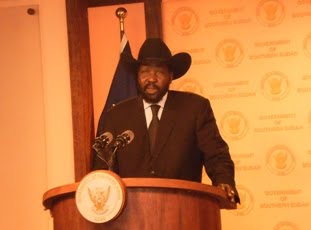

JUBA 8TH AUGUST, 2011
Your Excellency, Dr. Riek Machar Teny, Vice President of the Republic,
Rt. Hon. James Wani Igga, Speaker of the Joint National Legislature and the National Assembly of the Republic,
Rt. Hon. Joseph Bol Chan, Deputy Speaker of the Joint Sitting and Speaker of the Council of States of the Republic,
Honourable Deputy Speakers of both Houses,
The Honourable Chief Justice of the Republic,
Excellencies, Members of the Executive Caretaker Cabinet,
Honourable Members of this Joint august House,
Religious Leaders,
Representatives from all branches of government and states of the Republic,
Distinguished Members of the Diplomatic Community,
Ladies and Gentlemen,
This day is yet another momentous occasion for our nation. The convening of this First Joint Sitting of our two houses: the Council of States and the National Assembly is a historical episode in our life time. These two houses constitute the National Legislature, which is the supreme authority in the land. The interests of the people are fully represented in this noble institution. Thus, allow me the opportunity to congratulate you and welcome you to the first sitting of this august house.
Before I proceed ahead to share with you what I consider to be the pertinent issues of this epoch, please let us rise up and pay tribute to all those who perished in order for this nation to be born. Foremost amongst these heroes and heroines is our great leader and hero, Dr. John Garang De Mabior, whose fond memories are still vivid in our minds (Minutes of silence).
Thank you very much!
Rt. Honourable Speaker,
Honourable members of this august House,
Ladies and Gentlemen,
On July 9th, 2011, we ended a long period of misfortunes by the formal declaration of our independence. We have been occupied, colonized, marginalized and denied our dignity and humanity. This sitting clearly demonstrates the result of our long struggle and the beginning of a new journey for peace, democracy and prosperity. The independence we celebrated a few weeks ago is a great achievement for our people. I am grateful to have witnessed the birth of our nation and to you all comrades, congratulations for being pioneer citizens of this new nation! We are indeed a lucky lot because history has favoured us to be alive to witness this great moment of emancipation. Let us recreate ourselves, let us find new ways, new thinking and be ready to learn in order to adequately meet new challenges. We should not take anything for granted. Instead every challenge should be considered an opening for greater opportunities and triumphs. I urge all of you to seize the opportunities and accept the challenges of the future.
The freedom we have just achieved endows us with power and mandate. In return we must manage what is given to us with utmost care and responsibility. Moreover, as a sovereign body representing the sovereign will of the people of the Republic of South Sudan (RSS), it is incumbent upon this august House to manage the affairs of this land in order to deliver on what we promised to our people. While debating matters of national interest, it is important that we put the well being of our people and nation first. Our people have waited patiently for so long. It is time we act and we do so without delay. Therefore, the two houses must complement each other rather than compete against one another. This is expected of you in the conduct of business and this is critical for nation-building.
As a people who have navigated from far it may not be easy to forget the pains of the past. Our hearts are still heavy with the anguish of history. That notwithstanding we must be brave and wise enough to resist revisiting the past and we must embrace the future. We will not forget the past but the sacrifices of our martyrs will keep us consoled to be worthy of freedom and concentrate all our energies on nation-building. If we deviated away from the core objectives of our liberation struggle, the sacrifices made by many will be for nothing. We were able to achieve our objectives because of the sacrifices of our martyrs and the long suffering of our people. The rewards of our heroes and heroines lie in our future and in the realization of our vision. And it is also in this future and in the realization of this vision that we can fulfill the pledges we have made to our people.
Rt. Honourable Speaker,
Honourable members of this august House,
Ladies and Gentlemen,
Our dreams and hopes can only be met through hard work so that they can become a reality. A democratic and stable South Sudan will contribute to regional and international peace and prosperity. Remember, our independence also has its burdens and we must be ready to face them headlong. As I have pointed out in my past appeals, the worst experiences of the past and those of other nations must be considered in order for us as a new nation not to repeat them. We should not defend ourselves by using the failures of others as a threshold. Let us build our country by striving towards what others have achieved successfully.
As we move forward, the most serious challenge and responsibility we face is what we can deliver for future generations? What would be the best way to honour our heroes and heroines? I said it during Martyrs Day and I will repeat it here that there is nothing material to offer worth the sacrifices of our martyrs. What is worth the ultimate sacrifice they made is for us to build this nation. Nation-building requires cohesion, hard work, honesty and altruism. While I will continue to urge you to work harder, I am already at work. My next government will do the best it can to enhance the welfare of its citizens. Building a nation is not an easy enterprise. It takes time and in most cases those who build hardly reap the fruits of their own labour. Thus, let us keep in mind that we are here to serve our people and not to enrich ourselves. It is our duty to ensure that future generations must not experience the sufferings we have endured. In other words, let us end the promises and deliver the basic services to our people. Misfortunes of the past should end with us and let us set a brighter future for our people.
Rt. Honurable Speaker,
Honourable members of this august House,
Ladies and Gentlemen,
Together with the honourable members of this august Assembly, we must now focus on delivery of basic services to meet the great expectations of our people. This is only possible if we have a government whose first, second and final priorities are public interest, public interest, public interest! Let me make it clear once again that those individuals who are not willing and ready to make the sacrifices necessary to help our people will not be part of this government. Most important, the people of South Sudan will not sit ideally and allow corruption and abuses of public resources to continue unabated. You will agree with me that the people of South Sudan have not only suffered for far too long but they have also waited for basic services for too long. They cannot wait much longer. It is time for delivery and it is also time to put the public interest as the number one priority.
I take this opportunity to announce to this august Assembly that I will appoint the new Government of the Republic of South Sudan this week and according to constitutional requirement I am sending the list of the new cabinet to you for approval. The Ministers that are selected will have to work very hard and be disciplined. The new Government will work towards the ambitious goals set in our National Development Plan, and I will set them to task.
Firstly, for South Sudan as a new nation to develop, we need education. No country has ever achieved development without educating its population. It remains a major challenge that only a minority of our children in South Sudan have access to education. When it comes to girl’s education, it is even worse. All children in our independent country must have the opportunity to go to school. To do this there is a need to scale up education enrolment quickly all over the country. Together with our development partners we can achieve this. We will also encourage our communities to help build schools. To demonstrate our seriousness, within the first 100 days of the new government 30 new primary schools and four new secondary schools will be under construction. Together with our development partners, we will also launch a Teachers Training Development Program aiming at training 7000 teachers in the next three to five years. We are also going to build higher education institutions in the coming years. We cannot afford to lose our next generation leaders because of the absence of higher education institutions.
Secondly, the lack of good health care system in South Sudan has made our nation the most difficult place to live, especially for children and senior citizens. Many people still die because of preventable diseases. Let us be honest, you and I, and indeed our family members can afford to go out of the country to get treatment. But this is not the case for the millions of our people. And it is not because of war, rather because of the absence of health services. It is time to change that by providing basic health services for all our people in the villages, Bomas, Payams and Counties. Through community health programmes we can distribute anti-malarial bed nets to more people and save the lives of our children and their mothers. And we will start now.
Similarly, within the first 100 days of the government and together with development partners, we will make sure that 600,000 children are vaccinated against deadly diseases, including measles, particularly in the four states of Unity, Northern Bahr El Ghazal, Warrap and Upper Nile. And the good news is that 30 community midwives will finalize their training and be ready to be deployed to the rural areas. I also intend, with the support of this august House, to construct 100 small health care centers within the first year of this Administration.
Thirdly, South Sudan cannot develop without infrastructure. Our country is vast, and our communications are limited. Only through the use of roads and rivers can communities connect, agricultural production takes off, businesses flourish, the economy grows, and services are delivered. Infrastructure is at the heart of our development plan. Together with our development partners, we will invest in roads and bridges, and in river transport. But also here, we need our people to give a hand. They can help rehabilitate and construct feeder-roads. With the focus of this august Assembly, together, we can make it happen.
Within the first 100 days of the new government two roads and two airstrips will be opened in Unity and Warrap states. The repairs of Juba Bridge and the construction of a new bridge on the Nile donated by the Government of Japan will get underway. The rehabilitation of four roads will be in process, three in Eastern Equatoria State, Warrap and the Pagak-Mathiang road in Upper Nile.
Fourthly, no country can develop without abiding with basic principles of justice and rule of law. South Sudanese have been at the receiving end of aggression, injustices, arbitrary detention and absence of law and order during decades of war. Now similar incidences have occurred among our own police and security institutions. As I said on Martyrs’ Day, this has to end. Criminality should cease or else those who perpetrate suffering to others will be subjected to the strong arm of the law. It is time to put our own house in order. We need to strengthen law and order, both within our own institutions and among citizens.
Within the first 100 days of our new government, 50 new police stations located throughout the country, will be opened. Two prisons will also be completed. Again together with our development partners the Government will do more.
Fifthly, no country can ensure peace and security and protect its citizens without a modern and professional Army. As a new and independent country, we will complete the transformation of the SPLA into a national army. For this to happen successfully, the Government must put in place programs that would provide new opportunities for former SPLA soldiers.
Within the first 100 days, we will launch our new programme for Disarmament, Demobilization and Reintegration (DDR). We will provide tailored programmes to give them a new start.
These are just but few caveats for the beginning. We have got more daunting tasks in front of us – development, development and development! And development does not only come with the donors or with oil money. As I said earlier it requires hard work and discipline. For example, the Republic of South Sudan should never depend on imports of food or handouts. We are endowed with fertile land. I said it and I will repeat it now; we must till the land to produce food. This is a moral responsibility for citizens – work, work, work and work! I want to reiterate again, a prosperous nation is not made up of indolent citizens, because laziness is useless. As pioneer members of this joint august Parliament, I call upon you all to help mobilize our communities to service in order to help develop our nation. We can only achieve our ambitious development goals if all of us dedicate ourselves to develop our country and pull together with unity of purpose.
On Independence Day I made it clear that from now onward we do not have any excuses or scapegoats. It is our responsibility to protect our land, our resources and ourselves and to develop our country. Moreover, the goat is dead therefore there is no one to blame!
Rt. Honourable Speaker,
Honourable members of this joint august sitting,
Ladies and Gentlemen,
For South Sudan to succeed, we need to abide with the principles of transparency and accountability. Only then can we build a strong foundation for our new nation. Another word for corruption is stealing and it is called ‘stealing’ because money which should have gone to build our country is stolen by selfish persons. Those who engage in corruption are undermining our country and the sovereignty of the Republic of South Sudan. To borrow from our liberation laws, join me in defining corrupt persons as the enemies of the people. We must therefore fight corruption with dedication, rigour and commitment. And that is why, on Independence Day, I pledged to the people, the nation and the heads of state and government present that I would do all that I could to remove this cancer.
Most important, let me put a human face on what corruption does to our people and country. With the amount of funds stolen over the past six years and half; we could have saved thousands of our citizens from unnecessary deaths and suffering, building more than a dozen of schools and hospitals, and feed many of our citizens.
At this juncture, allow me to take permission from this august Assembly to outline key priority expectations of your business in the first 100 days. This requires us to change the way we have been doing things and become more disciplined. For example, timekeeping has been one of the worst vices of the old Sudan. This honourable legislative body has loads of work to deliver to this nation, critical amongst which is legislation itself. We must pass crucial laws to cement our sovereignty and independence. There is need to work even extra harder in order to expedite the process of legislation and achieve the following:
One, in the first 100 days I will make sure that the new Government of the Republic of South Sudan passes 5 essential laws to establish full transparency and accountability in the management of our financial resources, natural resources and oil. Thus, we will send to Parliament a Public Financial Management and Accountability Act, a Procurement Act, an Internal Audit Act, a Petroleum Act for regulating the management of oil resources, and an Oil Revenue Management Law for sustainable and transparent management of the oil income.
Several of these laws are already prepared, and all of them will hold international standards. This is an essential part of putting our new Republic on a solid foundation cemented by the blood of our martyrs. I call upon you, the National Legislature of the new Republic of South Sudan, to process and pass these laws without delay. We need them to take effect as soon as possible.
Two, implementation of these Acts is essential. Within the first 100 days, the Republic of South Sudan will develop an implementation plan to put these policies into practice. This includes rules of procedures for our public service and large-scale training of staff. Here, we will have to ask for external assistance and support. We need to be ready to implement expeditiously as soon as Parliament passes these laws.
In the first 100 days, the Audit Chamber and the Anti Corruption Commission will also be strengthened. We will have audits underway in three of the most significant spending government ministries and agencies. We will take action on their findings and as I have pointed out before there will be no loopholes for people who are addicted to mishandling public resources. There will be no sacred cows this time round. Moreover the Anti-Corruption Commission has already been granted the right to independent investigations but the institution itself also requires restructuring. I will urge the Commission to make use of this right within the first 100 days. The Commission and its members will have my full support as President of the Republic.
Three, implementation always starts at home with us as political leaders. In all South Sudanese communities stealing is seen as deeply shameful! We all know what happens in our cultures and communities, particularly, if one is caught stealing? The community will start composing songs against you, and the whole family will be disgraced. Your children will have difficulties getting married respectably, and you cannot even become a chief or be in any position of authority.
I always wonder what has happened to these core values of our communities. It seems that people have forgotten them. This has to change and with determination it will change. We must set new standards to be eligible for public office. When the government is appointed I will make these standards clear to the public, and I will expect every Minister and civil servant to abide by these standards. The Republic of South Sudan will expect nothing less from those who serve our newly independent country.
With these actions, I hope we will have taken the first critical steps to put our new country on a solid footing. Remember no government performs well without checks and balances. The primary role of Parliament is, therefore, essential in this process. I request you, our Parliamentarians and our international partners, to assist us and to hold us responsible in the implementation process of these pledges. I will report back to you on all these deliverables when our first 100 days have passed. I promise you that this time, we will deliver.
Rt. Honourable Speaker,
Honourable Members of this Joint Assembly,
Distinguished Ladies and Gentlemen,
I shall be remiss if I do not say something about the Comprehensive Peace Agreement (CPA), particularly about the issues that are still outstanding. I would like to reassure all that Abyei is not a forgotten cause because we will remain actively seized of the matter until a final resolution is found. We are all aware that the United Nations Security Council has authorized the deployment of the UN Interim Security Force for Abyei (UNISFA) in order to ensure resettlement of the people of Abyei back in their homes. I trust that a final solution will be found that will reflect the true will of the people of Abyei. I am equally committed to ensuring peace and security along our common borders and the spirit of good neighbourliness is one of the guiding principles of our foreign policy. The massive attendance of the world during our independence celebrations is testimony that we are a friendly people. We will continue to engage with all our neighbours, particularly with the leadership in the Republic of the Sudan to build strong relations because we share a long border.
Finally, I would like to repeat what I said during the declaration of independence. Let us continue to celebrate our hard won freedom but we must always be sober to wake up the following day and work. I reiterate my appeal to this august House that this new nation is yours and let us commit ourselves to build it with optimism. Hard work is a virtue and in just a matter of time, we will prosper. There is nothing impossible and as it is said: ‘If there is a will there is a way’. The role of government is to provide a conducive atmosphere while citizens must join hands and work. We will issue comprehensive priorities for the next five to ten years as soon as the new cabinet is constituted.
Let me say this again we cannot prosper as a nation without the unity and harmony of our people. We must accept our diversity and use our difficult past experiences to grow. We must work harder and harder so that in five years change must be apparent. Government will ensure that there is no hindrance or obstacle and people should go about doing their businesses in safety and without any kind of fear.
As for you the honourable members of this joint august House, legislation is your first order of business and I wish you all well in this national duty. I am always available and my office is there to attend to urgent national needs and emergencies.
Let us start to work right away.
Thank you all and may God bless South Sudan!
Subscribe to:
Posts (Atom)